• I ran 1770 miles in 2024. 

    Whoo-hoo?

    I won’t humble brag–I am proud of this achievement. I think this is the most miles I have ever run in a year. But I also know this may not have been the best use of my time and effort. It took me slightly over 290 hours, which is approximately 1.72 weeks of my life, to run 1770 miles. I almost certainly passed the point of diminishing returns somewhere in there. 

    In the world of running, “junk miles” refers to running that doesn’t help one get better as a runner or achieve any running goals. With that definition, most, if not all, of my 2024 miles were junk. 

    Actually, I didn’t have any running goals for 2024, at least not any related to running a race. I didn’t run any race in 2024, except maybe the Women Run the Cities 10 Mile. I say “maybe” because I signed up to run it as a virtual (on my own) race, but I never actually ran 10 miles with the intent of it being for that race. 

    I do find it interesting that I ran so many miles in 2024 without training for a race. I ran more miles last year than I did in 2018, when I trained for two marathons. I racked up these miles with many, many, short and mid-range runs but without any long runs–I only ran 10 miles 3 times. I never even ran a half marathon distance. So in some ways, this is an illustration of how little and consistent efforts add up. (It’s also an illustration of how lucky I am to have a flexible life and the ability to fit runs in at odd times, and a recognition that the weather and air quality was pretty conducive to outdoor running in 2024).  

    Perhaps paradoxically, I may also have run more because I wasn’t training for any races and so didn’t consider rest days. Since I wasn’t worried about my running performance, I didn’t feel like I needed to factor in time and opportunity for my legs to recover so I could eventually run faster.

    Ideally, as I think back on how many miles I ran in 2024, I’ll consider some questions of purpose and priorities. I’m fine with not improving as a runner or reaching any specific running goals, but is my running serving my overall physical and mental health? 

    Maybe? Sometimes? 

    These colorful Pride themed Brooks Ghost shoes carried me through many miles

    I do some other exercise activities besides running, but certainly some more variety would do me good, both physically and mentally. Running is my go-to because it’s “easy”–I know how to do it, and I can usually do it (weather permitting) without too much planning. I feel like I get the biggest bang (in my case, calorie expenditure) for the buck with running. Of course, calorie expenditure isn’t the best reason for exercise, which brings me back to my purpose and priorities question. 

    My running total for 2024 is likely a sign of some level of unhealthy obsessions, but I like to think it’s also a sign of my determination and perseverance. I’m not particularly motivated to make any significant changes to my approach to health in the near future (yes, I intellectually understand the value of  strength training and yoga and meditation and rest and recovery, etc.–no need to try and convince me) so I’m choosing to see the positive in my status quo. 

    I know I’m extremely lucky to be able to rack up so many running miles–it demonstrates not only a flexible schedule and good weather (and a gym membership for when the weather doesn’t cooperate) but being healthy enough and injury free so I can keep running. I realize this probably won’t last–someday I’m going to have to change my running ways. But I’m not there yet. 

    I think there are still plenty of unflattering after running selfies in store for me in 2025!

  • I sincerely thought my life was in danger. 

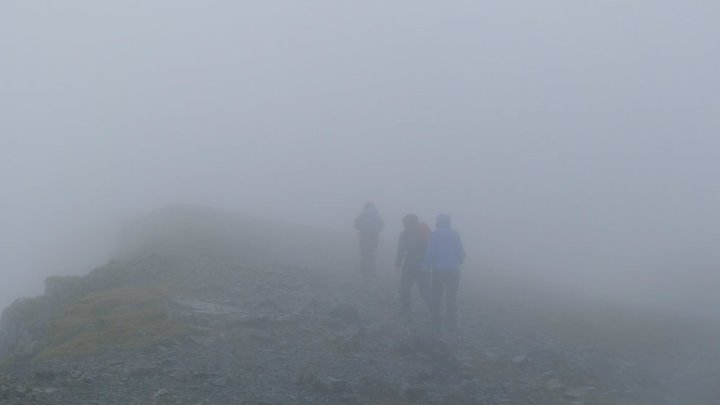
    It was June 2011, and Chad and I had just climbed up a mountain in Scotland. It was extremely windy, so windy that I literally had difficulty standing up in the wind. The wind blew me down at least once. It was also extremely foggy, so I couldn’t see that far ahead of me. Chad was holding onto me, but I thought there was a reasonable chance that the wind could literally blow me off the edge of the mountain, or at least knock me down causing me to roll down the mountain and land in a painful heap. And if the wind didn’t get me, I thought I might fall off the mountain because I couldn’t see where the edge was. 

    Thanks to a post I made on Facebook, I know the name of the mountain was Ben More, and we climbed 3,169 feet. In my mind, we had made it to the summit of Mount Doom (one of the few Tolkien references I will ever feel brave enough to make). 

    Later, once the perceived danger had passed, Chad corrected my interpretation of the experience–I wasn’t really in danger of blowing off the mountain and over the edge, although he did confirm that tripping and falling because of lack of visibility was a legitimate concern. 

    I don’t think I voiced my concerns to Chad, or to the two other hikers who were with us (John, our guide, and Kristina, our other tour group member) at the time. Maybe I wasn’t sure we were really in danger, and/or was too embarrassed to say so? Maybe I didn’t think it would do any good?

    I am a little chagrined that I don’t remember thinking too much, if at all, about Chad’s safety, or about how John and Kristina were doing. Again, maybe I just assumed they were all more competent than me, and knew how to not blow and/or fall off a mountain. Maybe I thought screaming “We’re all going to die!” wasn’t going to help, and I didn’t have much else to offer in the situation? 

    Once we made it down off the top of the mountain, I felt exhilarated and mighty. I felt even better when I was back at the hotel, warm and dry, sipping some whisky and basking in my accomplishment and feeling proud because I was such a badass.  

    I’m reminiscing about this now because today our church service was about living on the edge, and we had the opportunity to share some type of reading during the service. Of course I volunteered to participate in the service–I wasn’t going to miss out on the chance to stand in front of a microphone. I thought maybe this experience of being on a literal edge of a mountain would be good material for our service, but eventually opted to repurpose one of my previous blog posts about being on an emotional edge. Not surprisingly, I have more than a couple of those (frequently involving food and Chad). 

    But I can’t let any content product go to waste, so now I’m reverse engineering a draft of a piece intended to be read aloud into a blog post (is this meta?)

    I didn’t dress properly for a Scottish mountain hiking adventure and I was wet and cold for most of the time, so this experience definitely taught me the value of investing in the proper attire for outdoor activity. I also learned that just because I feel like I’m in a dangerous or risky situation, I may not really be on the edge of something or in harm’s way. It may be hard to stand up in a literal or metaphorical wind, and I may not be able to see or understand my surroundings, but that doesn’t mean I’m really going to be blown off the mountain. 

    If I survive my experience of being on the edge–whatever it is–I’m going to feel stronger and braver, which might even lead me to try new things and take a new risk. It’s definitely going to make that after accomplishment drink (real or metaphorical but I hope it’s real) taste even better.

  • Me: “It’s impossible to find underwear at Target that isn’t thongs or boyshorts!”

    Chad: “I think you’re exaggerating.”

    Of course I was exaggerating, but I was extremely frustrated. I had just spent soooo looong at Target looking at underwear, and I despaired that all my time and effort had been wasted. (I spent even more time at Target because they now apparently hide most of their panties in drawers. Without my friend Sandy who figured this out, I would have thought Target just stopped carrying much in women’s underwear). 

    I worried that I failed in my mission to find underwear suitable for an upcoming scene in a play where I would briefly (no pun intended) be onstage wearing an open robe and “flashing” the audience and showing them my bra and panties. It was a short moment–maybe 30 seconds?–but important to my monologue, and to me. Not surprisingly, I was feeling a little nervous and weird about the scene, even though I actively and enthusiastically sought out the role, and being onstage in my underwear isn’t a totally novel experience for me (perhaps I can write more about that in another post). 

    I was looking for underwear that was as flattering as possible AND not too risque or revealing. But it also had to fit my character, Mary, and a remark she would make: “It’s laundry day, I don’t normally wear these” suggesting that her panties (or knickers as Mary called them, since the playwright is from New Zealand) were embarrassing in some way. To make things more complicated, I needed two identical pairs of panties, as I needed one to wear and one to toss. 

    Oh, and I also needed panties in a bright or dark color, as I was afraid if they were too light or pale they might not show up again my white white skin and the audience would be scared that I WASN’T wearing any underwear at all. 

    High waisted “granny” panties (apologies to the grandmas out there) may seem like an obvious choice–funny and modest–but I also wanted underwear that I would wear again in my real life, and the granny style just doesn’t feel flattering or comfortable to me. Since I wasn’t excited about owning any granny panties at all, I definitely didn’t want to buy them in packages of 6–the only way Target sold them. (My hope that I could wear my character underwear in real life also ruled out thongs and boy shorts for me, in addition to neither being stage appropriate. It seems obvious why a thong wouldn’t be a good costume choice for me, but boy shorts seemed too hip for my character). Yes, in theory, I could shop somewhere other than Target, but I had already unsuccessfully looked online and there was just no way I was spending more time going to stores outside my normal life path. 

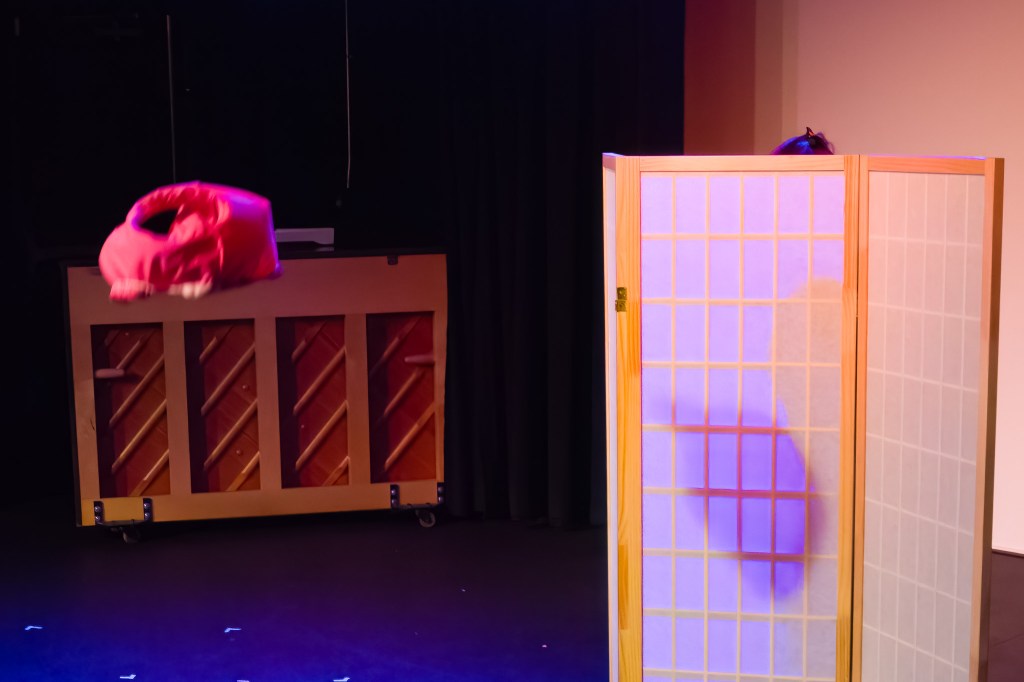
    Thanks to Jim Lundy for this impressive photo of my undies mid toss. Yes, they look like a shower cap!

    Eventually, I did end up buying underwear in bulk (I bought two packs of 6 instead of the individually sold panties that I searched so long for) but I was able to find “briefs” rather than granny pants, provided by the classic brand Hanes. Or maybe they were high waisted bikinis–it’s all starting to blend together. I didn’t find undies that were particularly funny, but I went with hot pink–a color bright enough to stand out on my pale skin, and while not necessarily humorous or embarrassing, at least a little silly.

    After all that time and pondering, I think I was successful: I felt good about how my monologue went, and audiences seemed entertained and no one seemed too scandalized by their 30 seconds of seeing me in my underwear. AND I’m even finding my 10 new pairs of undies a welcome addition to my wardrobe!

    I’ve been using the term “underwear” and “panties” interchangeably throughout this post. I did consult The Google to see what the official difference is (to me, “panty” sounds a little more sexy, “underwear” more utilitarian) and according to Google, “panties” refers specifically to feminine undergarments while “underwear” includes male and female clothing. I also think “underwear” can include bras, but I didn’t feel like I needed to buy a new bra for the play (although I did spend some time thinking about the color and type I should wear, wrestling with similar questions of flattery and modesty). 

    A friend who saw the show recently asked how much time goes into putting a production together. He was thinking about things like the time it takes an actor to learn lines and blocking, which is substantial, but I think many would be surprised by the time and energy that can go into the details of costumes, props, set, etc. “Theater is like a package of underwear, you never know what you’re gonna get.” (Something Forrest Gump should have said.)

  • I don’t like solving puzzles (unless Wordle counts). I usually just give up. 

    But last night I was confronted with a puzzle/problem that I was very motivated to solve: How was I going to work out at the gym when my workout clothes consisted of tennis shoes, socks, a pair of capri length tights, and a swimsuit bottom?

    To spell it out, I was missing a crucial component of my workout wardrobe: clothes to wear on the top half of my body. I had no workout clothes to wear above my waist.

    This was my first trip to the gym in quite a while, and clearly my gym bag packing skills were rusty. It’s not that I forgot to bring a workout shirt and sports bra, it’s that I thought the black thing I grabbed from my pile of broadly defined activity clothing was a tank top with a built in sports bra, when it actually was the bottom half of a swimsuit. Hey, they were all the same color (black) and type of material, although, yes, the size was a bit different. 

    After I quickly went through the stages of “discovering a gym bag missing crucial workout” gear grief (which included searching my bag repeatedly for a hidden workout top) I decided I had four options:

    1. Give up and go home to work out on our exercise bike
    2. Go home and get a workout top and sports bra and return to gym
    3. Go to the nearby Target and buy something to wear on my upper body and return to the gym
    4. Work out wearing what I had with me

    I couldn’t bear the wasted time that options 1-3 would require and I didn’t want to be out in the cold weather any longer than necessary, and I’ve spent way too much time recently in our basement on our exercise bike. Could I possibly make option #4 work?

    Thankfully, yes I could, because: 

    1. My normal bra (a Jockey Bralette, please see footnote)* that I was wearing was very close to a sports bra (and I don’t have that much to sport) and
    2. I was wearing an old thin shirt under my sweater 

    I was dubious, but desperate, so bravely gave the workout a try. “Even if I only get a couple of miles in before I get too hot and too tired of adjusting my bra, that will be something,” I told myself. Surprisingly, I was able to do the entire workout I had planned on (including a 5 mile run) without being too annoyed by my attire. Turns out, as far as missing accessories and/or clothing at the gym tragedies go, this one wasn’t too bad (I think not having earbuds or my phone and having to workout without entertainment is worse. Luckily, I’ve never forgotten my shoes–I don’t think I could run in boots). 

    Post workout in non-workout upper body wear

    It DOES seem appropriate that I had this incident on the day my brother sent me a link to a website about amyloid proteins, which can cause “memory and thinking” issues if they build up. Choosing a swimsuit bottom as a workout top does seem like a thinking issue. My brother had told me about amyloids this weekend during my Thanksgiving visit, and I think he brought it up because “amyloids” is a funny name when you (or your sister) is named Amy. Until I went to the website, I thought he was saying “amylynn” and that this was a medication to alleviate thinking problems–perhaps even more evidence that “amyloid” not only has “amy” in the name but may also be named after me. (I also think it’s cool that “amygdala” has “amy” in it and I can mispronounce it to highlight the “amy”–I can make it fit to The Beatles “Lady Madonna”).

    Now that I’ve almost finished writing this, I see this incident was not so much a lesson in problem solving (if that was the case I would have MacGyvered a sports bra from gym towels) as much as in acceptance, changing perspective, and asking “why not give it a try”? It turns out that I COULD exercise in clothing not designated as such, and that, while not an ideal experience, the world didn’t fall apart because I wasn’t wearing officially sanctioned exercise wear to exercise. I wasn’t even mocked by my fellow gym goers (although they may have been too busy wondering if I was going to snap and murder someone for running into me while exiting the track). 

    I’m so, so sick of riding our exercise bike, but at least the next time I do so I can appreciate that I don’t have to worry about packing appropriate clothes. And. if I am unable to locate workout clothes for some reason, at least the cats won’t care if I exercise naked. 

  • “I was fifteen when Chad and I met…” I started to tell my therapist. 

    “Oh wait, I wasn’t actually fifteen, I was nineteen,”* I corrected myself. 

    I misspeak all the time, so it’s not surprising that I started an anecdote with a factual error. What is surprising is that I think I know why I made this particular slip-up: I’m currently in rehearsal for a one-act (“Our Dearest Friends”) where my character, Stacy, tells a story about when she was fifteen. 

    Life wasn’t imitating art, but art (or at least one tiny, but important, word from it) had burrowed into my mind and crept out of my mouth. 

    When I actually was fifteen (not at Ponderosa, though)

    I find it fascinating when I observe how my fellow community theater thespians experience the emotions of their characters. I don’t think I’m as impacted by acting in emotional scenes as others–I always feel a distance between myself and my character’s emotions. But then, I think I always feel a bit of a distance between myself and my own emotions (not sure if that’s because of my always present inner observer/narrator/critic, my rural German Lutheran upbringing, being a Gen Xer, the human condition, or what). 

    I may not deeply feel a character’s feels, but sometimes I do find connections between our lives–experiences, interests, personality traits, or fashion preferences (this isn’t that surprising since I usually provide my own costume so draw from my own wardrobe). Often a play I’m in reminds me of similar (even if very loosely) incidents from my own life. 

    Stacy’s story of being fifteen is about her father taking her out to a nice restaurant and not having enough money to pay for the bill. This reminded me of the time (or times?) when my dad took me to a “nice” restaurant–Ponderosa–when I was a teen or young adult. Luckily, we didn’t have any monetary issues, and I don’t remember much about us dining there. But the memory, slight as it is, does make me feel warm and fuzzy because it was unusual, and nice, to be out with just my dad. 

    Once the memory center of my brain gets ignited by a show, several memories can bubble up. Fictional Stacy’s dine and dash story also reminds me of a time when I freaked out because I didn’t want a server thinking my mom and I were going to leave a restaurant without paying. Actually, I was freaking out because we were in a restaurant at the mall I worked at in Iowa when a tornado warning went off, and I immediately went into an “Oh my god we have to get out of here NOW and get to shelter but we’ve got to throw some money down so the waitress doesn’t think we’re stealing mall restaurant food!!!” state of panic. I probably then proceeded to hyperventilate (I’m not good with storms, and my fear of them was even worse in my youth). My poor mom.

    Another scene from the play that has sparked a memory from my youth is when Stacy disappointedly tries to straighten up her disheveled drunken teen son. When I was wrapping up my Freshman year in college, I blearily opened up my dorm room door to greet my mother wearing a t-shirt as a pair of shorts, with my leg through one of the arm holes (I had other clothes on, too). Needless to say, I was not in a great condition to be moving my things out of the dorm room, and my mom wasn’t terribly happy with me that morning. 

    Stacy isn’t a very likable character–I describe her as “deeply flawed” while another character in the show refers to her as an “insufferable bitch”–so I’m reluctant to say that I identify with her too much. But I do love playing her, and if I’m honest, I can empathize with many of her feelings and her need to feel safe. While I can relate to Stacy’s motivations, hopefully I don’t usually act on them in the same way. 

    If some of Stacy’s words accidentally slip into my life, that’s okay–if you hear me telling you about StanLee’s drinking problem in the next couple of weeks, you can assume I’ve just confused my dog with my onstage son. Let’s just hope I don’t mix up the name of someone I know in real life with the name of a character I’m yelling at onstage (yes, that has happened in the past but luckily only during rehearsal). 

    And if I end up spending my therapy sessions talking about the fictional problems of characters I have played–well, that will be a little weird. But as I DO talk about backstage drama and anxiety and my thespian-related insecurities with my therapist, she’d probably find hearing about Stacy’s (and other character’s) problems more interesting.

    *A bit of a tangent that I can’t figure out how else to work in: Chad and I just observed the thirty-fifth anniversary of our first date! Chad shocked me by announcing this as Joys and Sorrows at church yesterday, which was very sweet (although he didn’t specify if this fell under the “Joys” or “Sorrow” category). He did make a joke about how we started dating in kindergarten and how we were drinking juice boxes, which made me point out later that I don’t think juice boxes existed when we were in kindergarten (we certainly didn’t have them in rural Wisconsin). 

  • I’m not a Halloween enthusiast, but I do have vintage Halloween socks. 

    I was going to call my socks “antique,” but Google says something has to be at least 100 years old to be an antique, and while these socks are old, they’ve only existed for about 25-30 years. So they don’t qualify as antiques, but Google does say an item merely needs to be 20-99 years old to be “vintage.”

    I am the original and sole owner of these socks. While I don’t remember their exact origin story, my mom gave them to me, and as she died 24 years ago this October, and I think I had owned them for a while before she died, I know I’ve owned them for at least a quarter of century. 

    There’s nothing terribly special or sentimental about these socks–I didn’t make a special effort to hang onto them after my mother’s death. It’s just rather random that I still have them (and a miracle that they’ve survived the clutches of StanLee, Evil Genius Sock Eater. It also seems miraculous that I still have both of them and haven’t lost one to the voracious appetite of the dryer deity). 

    How do (cheap) socks survive so long? How is it possible that so many years have passed since my mom died? How have I gotten so much older? How have I lived so much of my life without her? How is it possible that she never got to snuggle and wrestle with StanLee, Destroyer of Socks?

    A couple of weeks ago, Chad and I saw John Hiatt perform. He’s one of our favorite musicians, and it was a fantastic show. It was an especially emotional evening for us, as it was almost exactly 24 years ago when we did NOT see a John Hiatt concert because my mom was dying.  We had tickets to that show in 2000, and I agonized over whether or not I should drive back from Chippewa Falls to see it. My mom was clearly in her last days, but dying doesn’t usually follow a clear schedule. I wanted to be there for my mom’s death, but I also was (and still am) super cheap and didn’t want to waste the concert tickets (my mom would have appreciated that). 

    My sister told me she didn’t think I should go to the concert, because I would regret it if our mom died while I was gone. She was right–my mom died the next afternoon, and I appreciate that I didn’t go to the concert and that I was able to be there. 

    Now my sister is gone, too. But John Hiatt, and my Halloween socks, are still here. This all feels emotionally powerful, even though I can’t really say why. Perhaps it’s because time is feeling really compressed to me of late. The veil between the worlds is supposedly thin at Halloween. Maybe this includes the veil between past and present (I really felt this at the concert when John Hiatt surprised me by doing so many songs from his 2000 Crossing Muddy Waters album, from the tour we didn’t see). 

    And of course, my mom, and my sister, and my dad, and all our beloved pets and friends and other family members who have left this mortal coil are still here when we remember them and tell stories about them. They’re here, although not in a tangible way like my socks. 

    Maybe this time squishiness includes the future, too–I wouldn’t be surprised if my Halloween socks outlive all of us. 

  • As the summer was winding down, I noticed a lot of coverage in the media about the “Songs of Summer.” Not surprisingly, I wasn’t familiar with the songs that kept getting mentioned. I can say that I’ve heard of Chappell Roan and Billie Eilish, but that’s about the extent of my current pop music knowledge. 

    So I was thinking that the idea of a Summer Soundtrack wasn’t really for me, until I expanded my definition of it. I may not know what’s at the top of music charts, but I’ve heard, and performed, a lot of music this summer at open mics. (Top songs for me to play: Mad World, Here’s Where the Story Ends, Jolene, Suddenly Last Summer, and In Your Eyes).

    I was looking for a funny illustration, but this moody one surprisingly spoke to me

    Last year I did Waterfall Summer, and this year, I embarked on Open Mic summer. I did my first-ever open mic on June 6 at 56 Brewing, and by the end of September, I had performed at fifteen (or more) open mics at various breweries. This fall I’ve settled into a groove of mostly weekly Sunday afternoon open mics at Heavy Rotation in Brooklyn Park (big shout-out to Brenda B. and her husband, Jeff, who run this one, and for making it so welcoming and fun).

    My open mic experiences have been terrifying, exhilarating, silly, and fun. Many of my performances have been…well, let’s say, not so great. But some have been kinda okay. I count it as a win that my overall quality trajectory through the summer has been up. I don’t get nearly as nervous performing as I used to, which is a big victory. Performing at an open mic makes me feel brave.

    Why do I do this thing that I’m not super skilled at, that scares the bejesus out of me? Well, that’s probably something for me and my therapist to dig into, but if you know me at all, you know I love to perform. So with that underlying motivation, the simple answer is I do open mics BECAUSE THEY LET ME. I don’t have to audition or coordinate with anyone else’s schedule or do anything else that requires qualifications or luck or successfully arranging logistics. 

    I started doing open mics this summer as a personal challenge–I’d been wanting to perform at one for quite a while, but the idea terrified me, so I thought I should probably give it a try. I actually had a bit of a goal to do one sometime in 2024, taking inspiration from other friends who I knew had done them. So by the time June rolled around, I thought, I got to finally take the plunge and just do this (apologies to Nike). 

    For my very first open mic, I arrived and signed up early, and was the first person to perform. There were only about three people in the audience–perfect!–and I only did one song (now I usually do three songs, and there are usually at least fifteen people in attendance). 

    I’ve learned so much from my adventures in the open mic space: how to set up my keyboard relatively quickly (and to never refuse help in carrying my keyboard), that it’s a really bad idea to use paper music at an outdoors venue (wind, duh), how to appreciate beer more (yes, open mics all seem to be at breweries) and that I should try to pretend to be relatively confident and calm, as being overly apologetic for my lack of talent only draws attention to it and is just annoying. 

    I’ve learned to be better with rolling with unpredictably, as mini-disasters and mini-triumphs constantly pop up. One of the most memorable, and unbelievable, and wonderfully unexpected things that happened this summer was when the server whom I ordered my beer from said, “Are you performing tonight? You play keyboard, right? I heard last week that you were fantastic.” Of course I did a whole, “Really? ME?! You can’t mean me” bit, but there just aren’t a lot of keyboard players out there doing open mic, and I was the only one that night. And there was a young woman who did come up to me after I played the previous week who was extremely complimentary (Chad witnessed this and can even verify it). She actually seemed inspired to get more into playing music herself. I am still totally mystified by her reaction, but I love it. 

    Most importantly, I’ve learned there’s an awesome community of open mic performers and listeners. I’ve met so many talented, friendly, and supportive people who regularly gather to share their love of making and hearing music, and I’m grateful for the chance to be part of their tribe. Of course, I’ve experienced (and I’m sure caused) some awkward social moments, but that keeps life interesting. And open mics have given me a greater appreciation of being in the audience and the importance of cheering others on. (I recently got the feedback that I’m a really loud clapper–not necessarily a good thing, but perhaps a power I can carefully wield for good).

  • “How did she get dehydrated going to the laundromat? She was doing laundry, it’s not like she ran a marathon. She’s a grown-ass woman–doesn’t she know how to drink water?”–me, complaining about my sister, July 2019

    My niece (my brother’s daughter) brought up this rant of mine recently. She found it hilarious at the time, and it still cracks her up. I don’t remember it at all, but I don’t deny it. It totally sounds like me. I unleashed this tirade after my sister and I had a silly fight and she canceled our plans to get together, saying she couldn’t meet me because she was dehydrated after going to the laundromat. While I don’t remember the alleged dehydration situation and my subsequent rant, I do remember the underlying (overarching?) fight that we had, so I’m sure I was in a mood.

    While this probably isn’t the best look for me, in the spirit of honesty and authenticiy, I admit I still stand by my rant (and my sister probably had her own rants about me at the time). Putting aside my views on hydration and laundry, I love that my niece remembers this incident fondly, and that it still makes her laugh. I told her to please tell it as a story at my memorial service. (Yes, I hope that’s far in the future, but I’m always on the lookout for content).

    What strikes me most about this is not that I gave this diatribe, but that I don’t remember it at all. I can’t even blame this instance of amnesia on alcohol consumption. How many other things have I said and done that I don’t remember? And how many of these things do others remember? 

    Stay hydrated!

    My brother had some insight on this. Okay, my brother has wisdom to share about many topics, so that’s not unusual, but I think he’s onto something particularly notable with this. “Just think,” he said, “how you can say something that can impact someone for years, even though you don’t know what you said, or why you said it, or what state of mind you were in when you said it. And someone may interpret it in an entirely different way than you meant it.”

    Whoa–I often agonize over having said the wrong thing, or not having said the right thing, so this is rather scary. Since my anxiety dance card is pretty full, instead of obsessing about this as a warning to stop saying stupid things, I’m going to focus on how my offhand comments can impact people in a positive way (or at least entertain them). I’m going to try and throw out more random compliments and encouragements, instead of criticisms and insults. I’m also going to try and mellow out about those things that people have said to me that I replay in my mind and analyze over and over–it’s possible that something I find memorable or important was just a throw away comment that they’ve forgotten. 

    In the parallel universe where my sister and I had a more functional and healthy relationship, we would have had a mature, honest, and direct conversation about our disagreement so she didn’t feel like she had to resort to the dehydration excuse, and I didn’t rant about behind her back. I can imagine that universe and see how we would have had a relationship that was perhaps more satisfying, but not more loving–or as entertaining. 

    And if I don’t occasionally say dumb things or indulge in petty grievances, I’m going to have a pretty boring memorial service.

  • I’m a pretty big fan of Minnesota Public Radio (although if you had told 20 year-old-me this was my future, I would have scorned your prediction). I appreciate many of their stories, features, and hosts, but I don’t remember ever being as interested in their content as when they recently aired a story about why lilacs were blooming in late summer.

    I tend not to be terribly observant about my physical surroundings, but I HAD noticed that our lilacs were blooming again in late August, and it was weirding me out a bit. It was messing with my sense of time (had I time-traveled back to spring?) and felt slightly apocalyptic. 

    The MPR story was very reassuring. It turns out (at least according to my interpretation of their story, and of course you should do your own research) this is something that happens sometimes when weather conditions–rainfall and temperature–are just right (or wrong?). And while these conditions are unusual and the lilac blooms are a sign that the bushes are under some stress, it doesn’t signal anything too catastrophic (and as stress reactions go, I wish I bloomed with lilacs rather than getting super sweaty…or maybe not). The story didn’t even mention “global warming.” 

    Like the lilacs, I’m confused by, and about, the changing of the seasons. I know this is hardly a unique take–for me, or for our culture at large. “Where did the summer go?” many of us joke and cry. The New York Times even had a piece recently on the “September Scaries.”

    It’s not that I don’t like fall, or that I love everything about summer. As a non-parent, I don’t even have the whole back-to-school thing to contend with. There are many little reasons and irritations that the onset of fall fills me with low level angst and melancholy, but I think it primarily comes down to the uneasiness caused by such an in your face exhibition of the transience of life. 

    The change from summer to fall isn’t a clear, clean switch. It’s an often murky transition (wildly changing weather being the most obvious example) and much of what we associate with fall (or any season) is arbitrary. Why can’t I wear bright colors in the fall? What universal law decrees that pumpkin spice flavored treats can’t be available year round (after all, they aren’t really flavored by actual pumpkins, but by chemicals that are constantly available). 

    I got a summer treat (rum) on the same day I scored this year’s first box of Special K Pumpkin Spice…on August 13 (I haven’t opened it yet).

    I think our collective and individual “rules” about the seasons are small rituals that help us cope with the change. To the best of my knowledge, we can’t control the passage of time, but perhaps we can affect how we experience it. 

    When I started writing this post, I thought I was going to proclaim that I was going to resist fall as long as possible and desperately cling to summer. None of this “meteorological fall starts on September 1” or “fall starts the day after Labor Day” nonsense for me–I’m clinging to summer until the equinox, at the very least. 

    But now I’m realizing I can put the Judgemental J dimension of my Myers Brigg personality aside and embrace the messiness of ushering in fall. I can’t stop the days getting shorter or the weather getting colder, but I can let summer and fall blend together, at least for a while. If I’m in the mood to wear a bright flower print while I marvel at the display of fall leaves, why not? I can have the best of both seasons–or at least try to. 

    Ecclesiastes/The Byrds tell us “There is a season turn, turn, turn.” That’s poetic and wise. But when I turn while dancing, I frequently turn in the wrong direction. And yeah, I also frequently do that while driving and walking (okay, any time I need some geographic grounding in the physical world there’s a good chance I’ll head the wrong way). So why not embrace my “wrong” turns as we’re headed towards fall? I’ll turn with the seasons…but there’s likely to be some back and forths and recalculations. 

  • (Author’s note: This is another piece I wrote for a recent church service, and Chad helped with it a bit).

    When our family’s beloved elderly Siamese cat, Chester, left this mortal coil, he climbed up on my mom’s lap, shared some of her bagel and cream cheese (just like he did every morning), and then he died. 

    It’s a beautiful image of a peaceful and loving final exit. 

    I don’t think it really happened. 

    It’s what my mom told me happened, but my mom had a way of presenting reality so that it conformed with her inner truth, rather than mere objective “fact.” So although I didn’t witness Chester’s death and I was living in a different state when it happened, I doubted my mom’s retelling of the event. 

    Chester and my sister Jenn

    I’m not saying my mom was a liar. She just never let the facts get in the way of a good story. When she did stray from the truth, I don’t think she even usually realized it.

    My mom was an entertaining and renowned storyteller. Or maybe not exactly a storyteller–she didn’t necessarily use a narrative form to captivate her listeners. But she was constantly sharing anecdotes and scenes and vignettes and interesting tidbits, some of the “friend of the friend” type and some about immediate family members. For simplicity’s sake, I think of all this content as “stories.”

    My brother and I call these stories my mom told “Big Fish,” after the movie and book about  a son – in the last days of his dad’s life – grappling with some of the fantastic tales his dad told throughout his life. The son’s relationship with those stories is pretty complex. He is bemused, inspired, and frustrated by them. I can’t speak for my brother, but I definitely identify with the son. 

    Trying to share my mom’s Big Fish “stories” is challenging–many would come off as highly confusing without a lot of set-up and our time is limited, so I’ll just focus on her lore of my birth. (If you are clamoring for more, I have blogged about quite a few of her stories and will probably continue to do so). 

    My mom had a lot of stories about my birth–how she got pregnant even though she was on the pill, and the doctors told her because of that I was likely to have brain damage and a severe cognitive disability. Also, I was a breech birth, so the doctor asked her if they should break my arm or leg to deliver me, but then I eventually did come out butt first. And because I was born butt first, I was the most beautiful baby because my face wasn’t all red and squishy. Oh, I also was born 6 weeks earlier than expected, but I wasn’t in the least bit premature. And double oh–my mom also made a point of highlighting that she and my dad rarely had sex, in fact, only two times–and I was the third kid. 

    Obviously, my mom’s Big Fish stories are important to me because they keep me feeling connected to her. Every time I think of one, and especially if I tell one, it keeps her memory, and even a bit of her essence, alive. It also connects me not only to her, but also to those who hear her stories, and especially to my brother and my now deceased sister and everyone who heard my mom tell her own Big Fish. 

    These stories also help me make meaning–of my mom’s life, and her death, and my family, and myself. They’re my inherited mythology. Sometimes these stories feel like a key that helps me unlock some of the mysteries of my mom. Why did she tell some particular strange and funny story over and over (beyond her love of performing, which I definitely relate to). What does the story say about what she valued? How she saw the world? How she saw herself? How she wanted us to see her? Even if I’m completely factually wrong in my theories, the  questioning still seems to lead me to some type of truth. 

    Maybe we all have a Big Fish. Maybe a whole school of them. I hope so.

    I never did question my mom about just how true her story ofChester’s death really was. What would be the point? Chester would still be dead, and the real truth of her story was that he was loved, and that my mom wanted to make Chester’s death as easy for me as possible because I was loved.