My mom doesn’t have much in common with Elizabeth Holmes. Yet I thought about my mom today when I listened to the latest episode of the “Critics at Large” podcast which featured the hosts discussing the new documentary about Elizabeth Holmes. According to the critics on the podcast, the fascinating aspect of the documentary (which I haven’t seen and probably never will) is how it explores the idea of truth and how people lie and how they can believe their own lies.
My mom wasn’t a fraudulent tech entrepreneur, but like Elizabeth Holmes, she did have an interesting relationship to “the truth”. As I’ve written about before, my mom didn’t deliberately try to deceive others (at least not more than the average person) and she certainly wasn’t a scam artist, but she definitely told “Big Fish” tales and I was never sure how much of her embellishments she actually believed. Perhaps more interestingly (or disconcertingly) my mom’s confident telling of her “truth” always made me question my own version of what I understood reality to be. This wasn’t in any way a form of malicious gaslighting (a term that wasn’t popular during my mom’s lifetime) but simply her way of being Colleen that caused me, and still causes me, to question my way of being Amy. (It also continues to entertain and amuse me).
I was likely primed to find connections between my media content and my mother today as it is the 26th anniversary of her death. I’ll admit, these anniversaries are emotionally awkward. I feel like it’s probably healthy for me to acknowledge them, but I also don’t see the value of making myself unnecessarily sad. I don’t want to dwell on all the awful memories of her dying and death, but I’m also trying not to repress things. (One grim but somewhat slightly funny memory is that my siblings and I had a little spat in my mom’s room at the nursing home as South Park was playing on the TV. No idea what the argument was about and it didn’t last very long).
I usually post something on Facebook to commemorate these dead relative anniversaries. I’m not sure how I feel about this weird way of sharing at a distance, of saying “Hey this is kind of a big thing” to potentially hundreds of people without having an emotional interaction with anyone in person. I think Facebook may even be helping me out in this circumstance because I’m not using it to avoid an interpersonal interaction–without Facebook I just wouldn’t let people know that today is the anniversary of my mom’s death.
I didn’t necessarily plan this as a way to commemorate this anniversary, but I spent some of today doing two of my favorite things in the world–hiking and listening to the aforementioned “Critics at Large” podcast. No direct connection to these activities and my mom, although she would be happy that I was enjoying myself (but she would be very confused about my hiking and probably freaking out that I was doing it alone so I would just have to not tell her about that).
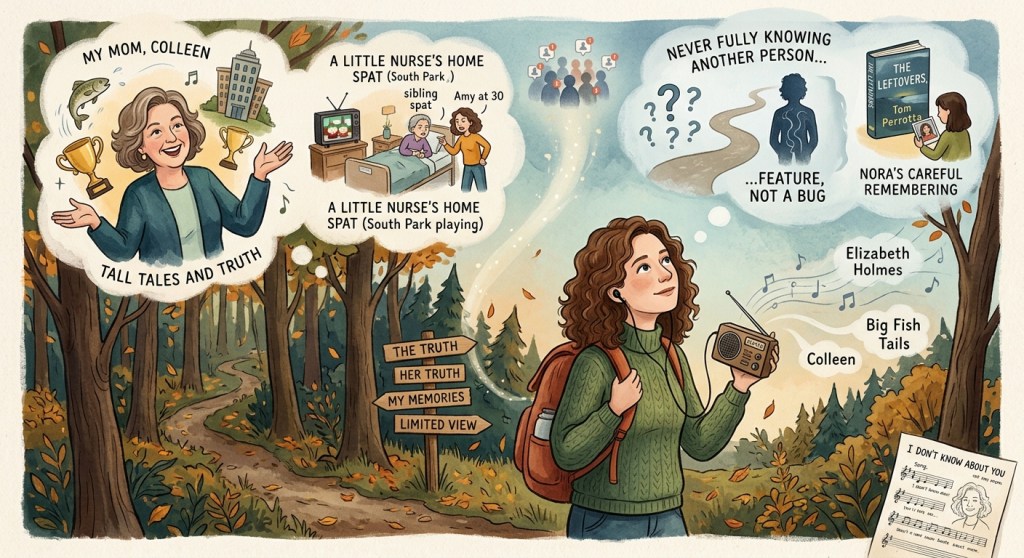
I also happened to listen to another thing today that made me think about my mother and what it means to know the “truth” of another person–a passage in the book “The Leftovers” (by Tom Perrotta) when the character Nora muses about remembering her dead (technically missing) family members. Nora describes how she is careful to not look at photos of her dead loved ones too often, not because she doesn’t want to remember them, but because she doesn’t want to get stuck in having only certain memories of them, or remembering them in a way that limits who they actually were.
I realized a while ago that my knowledge of my mother is limited by seeing her as “my mom”, especially since I was 30 when she died and I didn’t really have a chance to start seeing her as a full person beyond her role as my mom. But am I also limiting my memory of her because I’ve settled on a version of her that is accurate but not complete?
At a recent funeral at his church, Chad (yes, my husband is a bona fide minister) shared the insight from the Rev. Kate Tucker that we never fully know another person–and that’s a feature, not a bug. Whoa. Valuing the ultimate unknowability of others as a blessing, instead of something that points to our deficiency in connecting or our ultimate aloneness, is a revelation. Or maybe it’s a “yes and” revelation. Yes, in some ways we are so self-absorbed that we never truly know others, even our closest loved ones, because we’re too busy making everyone else the supporting characters in our own story. That’s rather tragic. AND…we can never fully know anyone else, or even ourselves, because people are just so complex and amazing.
I just realized that a year ago I wrote my first song, “I Don’t Know About You.” Yes, this song was also inspired by my mother and one of her favorite sayings, and here I am again, thinking about my mother and the mysteriousness of people. I don’t think my mom was trying to be too philosophical with her “I don’t know about you” quip and was going for a clear “I don’t know about you because you can be a dumbass” message. (At least I THINK that’s what she meant but I guess I don’t really know…)
There are so many things we don’t know–about other people and ourselves. Deception and ignorance are generally not desirable or admirable, but not knowing can be full of possibility. It can be frustrating and confusing and lonely not to really know or understand others, but there is always the potential to know at least a little bit more, especially if we are willing to loosen our hold on our ideas of who other people are.
*Bonus points if this title makes you think of the 80’s Spandau Ballet song


Leave a Reply